
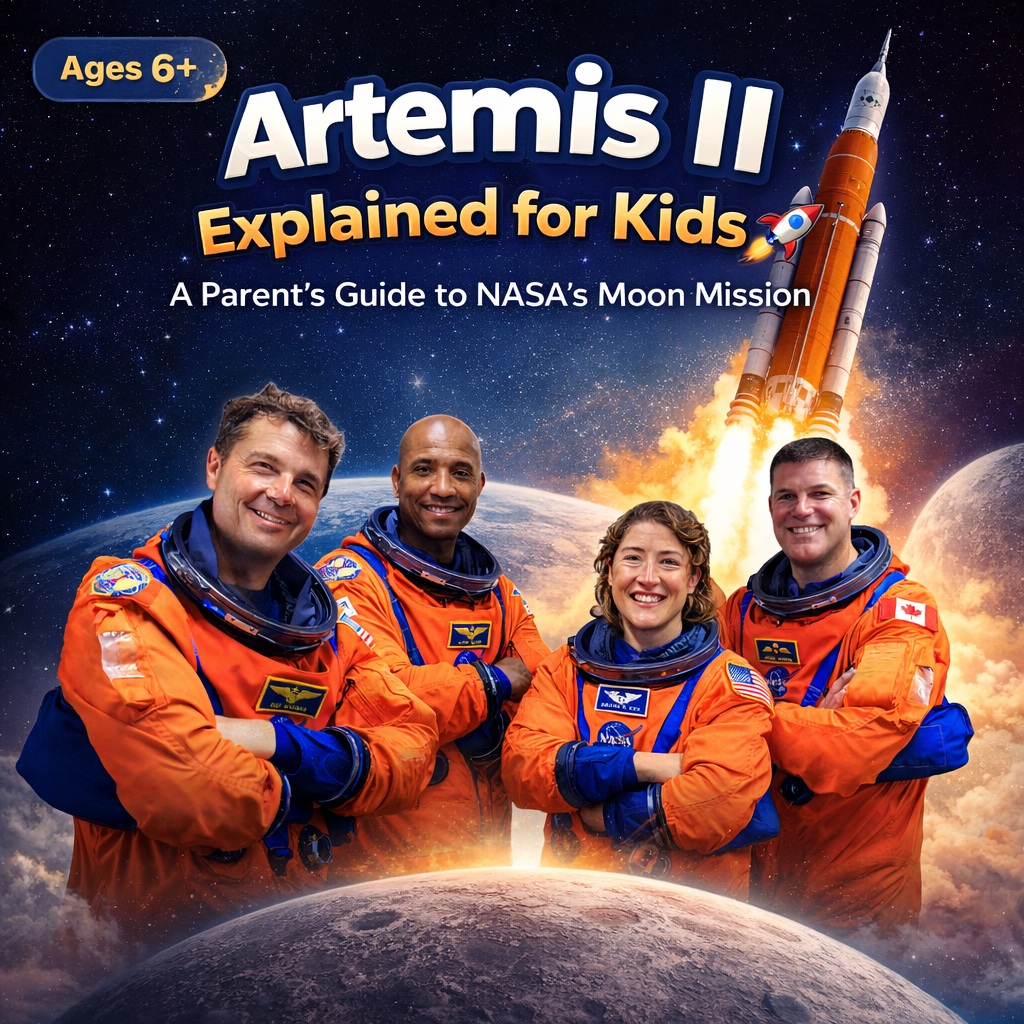
The Top 9 Questions Kids Ask About Artemis II
If your child is curious about space, there’s exciting news to share. NASA has successfully completed a significant space mission: Artemis II. This mission is the first time astronauts have traveled around the Moon in over 50 years. It’s a big step toward future Moon landings. In this guide, we’ll explain what Artemis II was, what happened during the mission, how you can discuss it with your child, and a crossword puzzle to tie it all together.
1. What Was Artemis II?
Artemis II was NASA’s first crewed mission in the Artemis program. It sent astronauts around the Moon and safely back to Earth. The mission launched on April 1, 2026, and returned safely on April 10, 2026, after about 10 days in space. Unlike the Apollo missions that landed on the Moon, Artemis II was a lunar flyby mission. This means astronauts traveled around the Moon but did not land. Think of it as practice before astronauts land on the Moon again.

2. Who Was on Artemis II?
NASA selected four astronauts for this historic mission:
- Reid Wiseman (Commander)
- Victor Glover (Pilot)
- Christina Koch (Mission Specialist)
- Jeremy Hansen (Mission Specialist)
This mission made history because:
- Christina Koch became the first woman to travel this far into space.
- Victor Glover became the first Black astronaut to go on a lunar mission.
- Jeremy Hansen became the first Canadian to travel to the Moon.
3. What Happened During the Mission?
Artemis II launched from Kennedy Space Center and traveled deep into space toward the Moon. During the mission, astronauts:
- Traveled about 240,000 miles from Earth.
- Flew around the Moon, including the far side.
- Temporarily lost communication while behind the Moon.
- Tested spacecraft systems like navigation and life support.
- Returned to Earth safely with a splashdown in the Pacific Ocean.
At its farthest point, the crew traveled more than 250,000 miles from Earth, farther than any humans have gone in decades.
4. Why Is Artemis II Important?
Artemis II is a major step forward in space exploration. Here’s why it matters:
- It proved humans can safely travel beyond low Earth orbit, the space close to Earth where most spacecraft operate.
- It tested the Orion spacecraft with a crew on board.
- It prepares NASA for landing astronauts on the Moon in Artemis III.
- It helps scientists plan for future missions to Mars.
- It supports future projects like the Gateway, a space station that will orbit the Moon.
In simple terms, this mission shows that humans are ready to explore deep space again.
5. What Is the Orion Spacecraft?

The astronauts traveled in a spacecraft called Orion. Orion is designed for deep space travel and includes:
- A crew module where astronauts live and work.
- A service module that provides power, oxygen, and water.
- A heat shield to protect the spacecraft during re-entry.
Kid-friendly explanation: Orion is like a small space home that can travel very far and bring astronauts safely back.
6. What Rocket Launched Artemis II?
Artemis II launched on the Space Launch System (SLS), one of the most powerful rockets ever built. This rocket is strong enough to:
- Escape Earth’s gravity.
- Carry astronauts into deep space.
- Travel all the way to the Moon.
7. What Did the Astronauts Experience?

During Artemis II, astronauts experienced things very few humans ever have, and they did it while helping NASA learn how to safely send people deeper into space.
1. Seeing the far side of the Moon
As the spacecraft traveled behind the Moon, the crew saw the far side, a part of the Moon that people on Earth never see. This side looks different, with fewer large dark areas and more craters. For a short time, the astronauts lost communication with Earth because the Moon blocked radio signals. This is expected, but it can feel dramatic—like being cut off from home.

2. Watching Earth become a tiny world
As they traveled farther away, Earth slowly shrank into a small blue sphere in the distance. Many astronauts describe this as a powerful moment called the “overview effect.” It can change how people think about our planet, making it feel more fragile and connected. Kid-friendly way to explain it: Imagine looking back at your house from miles away until it looks like a tiny dot.
3. Traveling incredibly fast
The spacecraft reached speeds of about 25,000 miles per hour when returning to Earth. That’s fast enough to go from New York to Los Angeles in just a few minutes. These speeds are necessary to:
- Escape Earth’s gravity
- Travel to the Moon
- Safely return home
4. Living and working in deep space
Artemis II was not just about the journey; it was also a test of how humans function far from Earth. Astronauts helped test:
- Navigation and control systems.
7. How Is Artemis II Different from Apollo?

While Apollo missions landed on the Moon, Artemis II focused on testing systems with a crew before landing again. Key differences:
- Apollo missions landed on the Moon; Artemis II orbited it.
- Artemis uses modern technology and systems.
- Artemis is part of a long-term plan to return and stay on the Moon.
8. Did Artemis II Land on the Moon?
No. Artemis II did not land on the Moon. It flew around the Moon and returned to Earth safely. The next step is Artemis III, which is planned to land astronauts on the Moon.
Why Are We Going Back to the Moon?
The Moon helps scientists learn how humans can explore deeper space. Reasons include:
- Studying resources like water ice.
- Testing technology for long missions.
- Preparing for future trips to Mars.
You can explain it to kids as practice for going even farther into space.
9. How to Explain Artemis II to Your Kids
A simple explanation is: “Artemis II was a mission where astronauts flew around the Moon to practice going there again.” You can compare it to:
- A practice game before a championship.
- A test flight before carrying passengers.
- Training before a big adventure.
Simple Activities to Do With Your Kids

Turn this mission into a learning opportunity:
1. Build a Paper Rocket
Use simple materials to design your own spacecraft.
2. Track the Mission Together
Watch videos and replays of the launch and splashdown.
3. Moon Observation Night
Look at the Moon and talk about the astronauts’ journey.
4. Draw the Mission
Have your child imagine what the mission looked like.
5. Create a Mission Plan
Ask your child what they would bring to space.
Bonus Activity: Artemis II Crossword for Kids
Want to make learning about Artemis II even more fun? We created a kid-friendly Artemis II crossword puzzle that helps reinforce key concepts like astronauts, spacecraft, and the Moon mission.

This is perfect for:
- Kids ages 8-12.
- Homeschool or classroom activities.
- Screen-free learning time.
You can grab it here: Download the Artemis II Crossword Puzzle
Tip for parents: Try doing the crossword after reading this article together to reinforce learning.
Key Space Terms to Know
Understanding a few important space terms can help kids follow the Artemis II mission better:
- Low Earth orbit: The space close to Earth where the International Space Station orbits.
- Deep space: Space far beyond Earth’s orbit, where missions like Artemis travel.
- Free return trajectory: A flight path that loops around the Moon and brings the spacecraft safely back to Earth.
- Lunar Gateway: A future space station that will orbit the Moon and support astronauts.
- Flyby mission: A mission that travels around a space object without landing on it.
- Diverse crew: A team made up of people with different backgrounds and experiences.
FAQ: Artemis II for Kids
1. What was Artemis II?
A mission that sent astronauts around the Moon.
2. Did it land on the Moon?
No, it orbited and returned.
3. What is a good chapter book series about space for kids ages 8-12?
The Space Bound series, by Bakken Books.
4. How long did the mission last?
About 10 days.
Final Thoughts
Artemis II is more than a space mission It is a real example of how humans are exploring space again. For kids this mission can spark curiosity about science engineering and the future of space travel. For parents it is a great opportunity to turn real world events into meaningful learning experiences. Who knows The next astronaut might be sitting at your kitchen table right now!












1 comment
Larry OLea Carranza
This was very nice to read. cooll