How to Play Mancala: A Step-by-Step Guide
Mancala is one of the world’s oldest board games, beloved for its simple rules and surprisingly deep strategy. Played with just a board and small stones, it’s a game that has traveled across centuries and cultures. In this guide, you’ll learn where Mancala comes from, how to set it up, the rules of play, and a few strategies to give you the upper hand. Download Step-by-Step Instructions
A Brief History of Mancala
Mancala is believed to be over 5,000 years old, with archaeological finds in Ethiopia and Egypt showing mancala-style boards carved into stone. Some historians even believe the game could be more than 6,000 years old, with the Romans playing versions of it nearly 2,000 years ago.
The word mancala comes from the Arabic “naqala,” meaning to move. Over centuries, the game spread across Africa, the Middle East, Asia, and later to Europe and the Americas. Each region shaped its own variation: Oware in Ghana, Bao in East Africa, and Kalah, a U.S. version from the 20th century.
Because of its reach, Mancala is often called “the game of the world”. Its rules teach patience, foresight, and strategy — qualities valued across many cultures.
Objective of the Game
The goal is simple: collect more stones in your store than your opponent.
What You Need
-
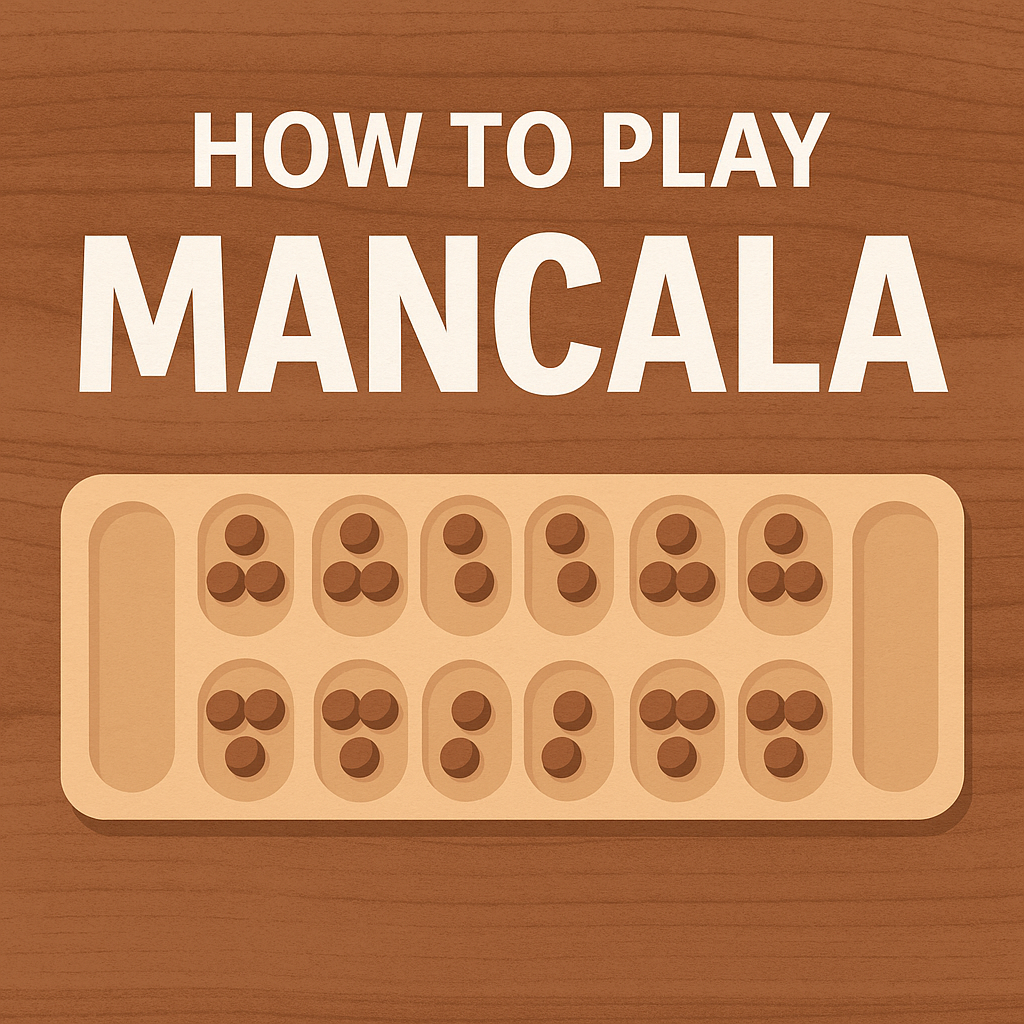
A mancala board (12 small pits and 2 larger “stores” at each end).
-
48 stones, counters, or seeds (4 per small pit).
Pro tip: No board? Try using an empty egg carton (12 cups) with two bowls for the stores, and small objects like beans or coins as counters.
Setup
-
Place the stones
-
Put 4 stones (or seeds, beads, etc.) in each of the 12 small pits on the board.
-
The 2 larger pits at the ends, called stores, start empty.
-
-
Where you sit
-
Sit across from your opponent.
-
The six pits directly in front of you are yours.
-
The big store to your right is also yours , that’s where you’ll collect stones during the game.
-
-
Your opponent’s side
-
The six pits in front of your opponent belong to them.
-
Their store is on their right side (which is to your left).
-
Quick way to remember: Your pits + your right-hand store = your side of the board.
Rules of Play
Step 1: Picking Up Stones
On your turn, select one of the six pits on your side of the board (the row closest to you). Take all the stones from that pit into your hand.

-
Example: If pit A3 has 4 stones and you choose it, you now hold all 4 stones in your hand.
-
Important: You can only pick from your side, never from your opponent’s pits.
Step 2: Sowing Stones Counterclockwise
After picking up, drop the stones one by one into the following pits in a counterclockwise direction.

-
Place one stone in each pit as you move along.
-
Include your own store (the big cup on your right).
-
Skip your opponent’s store — you never drop a stone there.
Example: If you picked up 4 stones from A3, you’d place one in A4, one in A5, one in A6, and one in your store.
Step 3: Getting an Extra Turn
If your last stone lands in your own store, you immediately take another turn. This is one of the key strategies in Mancala.

-
Example: If you place your last stone in your store, don’t stop — keep playing!
-
Tip: Skilled players plan moves so their last stone frequently ends in their store, chaining extra turns together.
Step 4: The Capture Rule
This rule adds a tactical twist:
-
If your last stone lands in an empty pit on your side, you capture that stone plus all stones directly opposite in your opponent’s pit.
-
All captured stones go into your store.
Example: If A5 is empty and your last stone lands there, you capture it and all stones in B5 (the pit directly opposite).
Be careful: Leaving empty pits on your side can give your opponent the chance to capture!

End of the Game
The game ends when one player’s six pits are completely empty. At that moment:
-
The other player sweeps all the stones remaining on their side into their store.
-
Both players count their stones.
-
The winner is the player with the most stones in their store.
Example: If your side is empty but your opponent still has 7 stones spread out, they collect those 7 into their store before counting totals.
Strategy Tips
Mancala might look simple, but strategy quickly comes into play:
-
Aim for extra turns: Plan moves so your last stone lands in your store. This snowball effect can give you back-to-back turns.
-
Set up captures: Time moves so you land in an empty pit opposite a loaded pit of your opponent.
-
Keep an eye on their side: As Punchboard notes, “It’s tempting to make sure you’re always depositing at least one counter in your mancala… but you need to keep an eye on which holes your opponent has empty”.
Why Play Mancala?
Mancala is quick to learn, fast to play (a typical game takes 15–30 minutes), and endlessly playable. It’s great for teaching kids counting and planning, while giving adults a fun, strategic challenge.
Final Tip: Play often! The more you practice, the more you’ll see patterns, setups, and winning moves emerge.